
For fragrance brands, the choice of cap material is far more than a sourcing decision—it directly shapes perceived product value, shelf appeal, and long-term brand equity. Zamac (zinc alloy) and plastic are the two most dominant materials in perfume cap manufacturing, each serving distinct brand tiers, price points, and market strategies.
As a China-based perfume cap manufacturer with 16+ years of production experience serving global brands, JSM has produced millions of units in both materials. In this head-to-head guide, we break down the real-world differences between zamac and plastic perfume caps across quality, cost, durability, design flexibility, and market fit, to help you make the right call for your product line.
What Are Zamac and Plastic Perfume Caps?
Before diving into comparisons, it helps to clarify what each material is and how it’s manufactured.
Zamac Perfume Caps
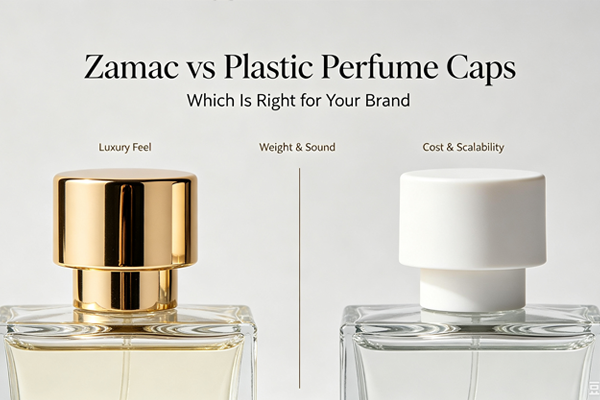
Zamac (also spelled zamak) is a high-purity zinc alloy (typically Zamak 3 or Zamak 5 grade) formed through high-pressure die-casting. It is the standard base material for nearly all premium metal perfume closures, including our signature enamel perfume caps.
The die-casting process creates dense, dimensionally precise blanks that can then be polished, electroplated, enamel-filled, or engraved. The result is a solid, weighty cap with a premium heft that consumers intuitively associate with luxury.
→ Explore our full range of zamac perfume caps for luxury fragrance lines.
Plastic Perfume Caps
Plastic perfume caps are most commonly made from ABS, PP, or SAN resin, produced via injection molding. They are lightweight, low-cost, and fast to produce, making them the dominant choice for mass-market and entry-level fragrance products.
While plastic caps can be coated or metallized to mimic a metal look, their core material properties set hard limits on durability, weight, and perceived quality.
Side-by-Side Comparison: Zamac vs Plastic Perfume Caps
Below is a full breakdown across the 6 factors that matter most to brand owners and procurement teams.
1. Tactile Feel & Perceived Value
This is the single biggest difference between the two materials, and the reason premium brands almost universally choose metal.
- Zamac caps: Solid, dense, and noticeably heavy. A standard 18mm zamac cap typically weighs 8–12 grams, 3–5 times the weight of an equivalent plastic cap. Consumers instinctively associate this heft with higher quality, and it creates a more satisfying opening and closing experience. This “weight psychology” is a well-documented driver of perceived luxury in fragrance packaging.
- Plastic caps: Lightweight, often 2–4 grams for the same size. While functional, they lack the substantial hand feel that signals premium positioning. Even with metallized coating, the light weight gives away their plastic construction on first touch.
For products sold at retail, where customers pick up the bottle before buying, this tactile difference directly impacts purchase decision.
2. Durability & Long-Term Performance
For brands building long-term product lines or selling through high-turn retail channels, durability protects your brand image on shelf and in use.
- Zamac caps: Highly resistant to impact, scratching, and deformation. The base metal does not degrade from UV exposure, temperature swings, or regular handling. When paired with proper electroplating, the finish remains intact for years without fading, chipping, or peeling. In JSM’s production data, field defect rates for zamac caps are less than 0.3% under normal retail conditions.
- Plastic caps: Prone to surface scratches, stress whitening on impact, and UV-induced brittleness over time. Spray coatings and UV metallization can wear off with repeated handling, leaving the cap looking worn. In high-heat shipping or display environments, thin plastic caps may also warp slightly, causing fit issues.
3. Surface Finishes & Design Flexibility
Both materials support decoration, but zamac offers far wider scope for premium, long-lasting finishes.
- Zamac caps: Compatible with a full spectrum of high-end surface treatments:
- Electroplating: bright gold, matte gold, gunmetal, antique bronze, rose gold, chrome
- Enamel inlay for vivid, permanent color patterns
- Laser engraving, embossing, debossing for logos
- Integrated magnetic closure structures → Learn more in our full perfume cap electroplating finishes guide
- Plastic caps: Limited primarily to spray painting, UV metallization, hot stamping, and pad printing. While metallized plastic can look similar to metal from a distance, the coating is thinner and wears off much faster. Sharp details and deep engravings are also harder to achieve cleanly due to injection molding constraints.
If you are considering a premium closure with satisfying click action, see our deep dive on magnetic perfume caps structure and advantages—a design almost exclusively built on zamac bases.
4. Cost & Minimum Order Quantity
Cost is often the deciding factor for mass-market lines.
- Zamac caps: Higher material and tooling costs. Unit price is typically 2–4 times that of a basic plastic cap, and custom mold costs are higher. Standard MOQ for custom zamac caps starts at 3,000–5,000 pieces per design. For premium-priced fragrances ($60+ retail), however, the incremental cap cost is tiny relative to the retail price uplift it enables.
- Plastic caps: Low raw material cost and simpler tooling make them highly cost-effective for large volumes. MOQs can be lower, and unit prices scale very favorably for orders in the tens of thousands. This makes plastic the default choice for body mists, drugstore fragrances, and promotional SKUs.
For a full breakdown of ordering costs, lead times, and tooling fees, see our custom perfume caps OEM step-by-step guide.
5. Sustainability & Regulatory Compliance
Global regulations—especially in the EU and North America—are rapidly shifting packaging decisions toward recyclable materials.
- Zamac caps: 100% recyclable. Zinc alloy can be melted down and reused indefinitely with no loss of material quality. Zamac caps easily meet REACH, RoHS, and California Prop 65 requirements, and they carry no microplastic risk. As EU plastic packaging taxes expand, metal closures are increasingly seen as the lower-risk, more marketable choice for premium brands.
- Plastic caps: Most standard plastic caps are not easily recycled in curbside systems, and mixed-material metallized plastics are even harder to process. While recycled resin options exist, they often come with higher defect rates and visual inconsistencies. For brands marketing sustainability credentials, plastic caps are a harder story to tell.
6. Production Lead Time
- Zamac caps: Longer production cycles due to die-casting, multiple finishing steps, and full inspection. Standard mass production lead time is 25–35 days after sample approval.
- Plastic caps: Faster injection molding and simpler decoration mean lead times of 15–25 days for standard orders. This makes plastic better suited for fast-fashion fragrance lines with short go-to-market windows.
Which Material Should Your Brand Choose?
There is no universally “better” material—only the right match for your brand positioning, channel, and price point.
Choose Zamac Perfume Caps If:
- Your fragrance line sits in the mid-premium to luxury tier (retail price $60+)
- You sell through department stores, beauty boutiques, or premium online channels
- You want your packaging to signal craftsmanship and justify a higher price point
- You are building a permanent SKU or collector’s edition where long-term finish matters
- You are targeting EU, US, or Middle Eastern markets where luxury metal packaging is the expected standard
Choose Plastic Perfume Caps If:
- You are launching an entry-level or mass-market fragrance (retail under $30)
- Order volumes are very large and unit cost is the top priority
- The product is a promotional SKU, gift-with-purchase, or short-term limited run
- You need extremely fast lead times for a quick market launch
Middle-Ground Alternative
If budget is tight but you want a more premium look, metallized UV-coated plastic caps can deliver a visual metal effect at a lower cost. Be aware, however, that the difference in feel and durability will still be noticeable to end consumers, and coating wear remains a common complaint. For brands aiming for true luxury positioning, zamac remains the baseline standard.
Frequently Asked Questions
Q: Are zamac caps really worth the extra cost? A: For premium and luxury fragrance lines, yes. Consumer packaging research consistently shows that solid metal closures increase perceived product value by 20–30% compared to plastic, far outweighing the incremental unit cost. For mass-market lines, the ROI is less clear.
Q: Can plastic caps be made to feel heavier? A: Some manufacturers add weighted inserts, but this adds cost and can create structural issues. The density of zamac is still unmatched for creating a natural, high-quality heft without compromising design integrity.
Q: Which material has more consistent quality in bulk production? A: When produced by an experienced factory, both can be consistent—but zamac holds tighter tolerances. At JSM, all our zamac caps go through 100% full inspection under our ISO9001:2015 and SMETA certified quality system, delivering far lower field defect rates than typical plastic cap production.
Q: Is zamac more eco-friendly than plastic? A: From a circular economy perspective, yes. Zinc is infinitely recyclable, and post-consumer metal recycling rates are much higher than for plastic packaging. For brands marketing sustainability, metal caps are a much stronger storytelling asset.
Q: Does JSM produce both zamac and plastic perfume caps? A: Our core expertise and production lines focus on high-end metal closures: zamac caps, enamel caps, and aluminum caps. We focus on what we do best: premium quality at scale. For clients needing full packaging sets, we can also coordinate trusted partner factories for plastic components as part of our one-stop OEM service.
Conclusion
Zamac and plastic perfume caps serve different purposes, and neither is inherently “better.” Plastic excels at low cost and speed for mass-market products; zamac delivers the luxury feel, durability, and brand equity that premium fragrance lines depend on.
For most brands building a premium identity, zamac is the baseline investment—and when combined with enamel inlay or magnetic closure design, it becomes a true brand differentiator on shelf.
As an experienced zamac enamel perfume cap manufacturer serving brands across Europe, North America, and the Middle East, JSM can help you evaluate the right material, finish, and structure for your specific project.
Not sure which material fits your next launch? Contact our engineering team today for a free feasibility review and customized quotation.