
In premium fragrance packaging, quality is not a detail—it’s a brand promise. A single defective cap on a retail shelf can erode a customer’s perception of your entire product line. For brands sourcing from overseas manufacturers, inconsistent quality is the single biggest source of wasted cost, delayed launches, and brand damage.
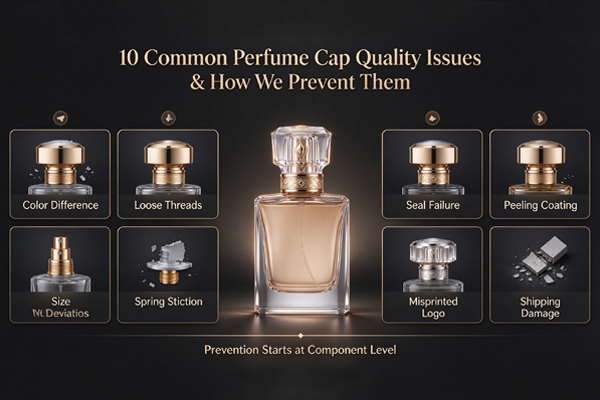
As a zamac perfume cap manufacturer with 16+ years of precision production experience, JSM has identified and systematically eliminated the 10 most common perfume cap quality defects. In this guide, we break down each issue, its root cause, and the specific process controls we use to prevent it from reaching your shipment.
Our approach is simple: build quality into every production step, not just inspect it at the end. Every cap we produce passes through our ISO9001:2015 and SMETA certified quality management system, with 100% final inspection before shipment.
The 10 Most Common Perfume Cap Quality Defects
1. Electroplating Color Variation
Issue: Caps from the same production batch show visible differences in tone, brightness, or color depth. Matte gold and gunmetal finishes are especially prone to this. Root cause: Uneven bath chemistry, inconsistent current density, varying substrate preparation, or different production batches of plating chemicals. Our prevention:
- We lock color standards against a signed golden sample, with color difference controlled to ΔE < 2.0—below the threshold of human visual detection.
- Plating baths are analyzed and calibrated daily for chemical concentration, pH, and temperature.
- Every production lot includes a control strip processed alongside parts to verify color consistency.
- Full production runs only proceed after a pre-production color panel is approved.
→ Learn more about finish standards in our complete guide to perfume cap electroplating finishes.
2. Enamel Bubbles & Pinholes
Issue: Small air bubbles or pinholes appear in the enamel surface, ruining the smooth, premium finish. Root cause: Trapped air during enamel filling, improper substrate preparation, or too-rapid temperature rise during firing. Our prevention:
- Recessed enamel areas receive controlled sandblasting before filling to create a porous, adhesive surface that releases air evenly.
- Enamel paste is vacuum-degassed before application.
- We use a stepped temperature ramp during curing instead of instant high heat, allowing air to escape gradually.
- Every enamel cap is visually inspected under magnified lighting after firing, and defective units are repaired and re-fired.
→ See our full step-by-step enamel perfume cap manufacturing process for more quality control details.
3. Dimensional Tolerance & Fit Issues
Issue: Caps are too loose and fall off, or too tight and difficult to remove. This is the #1 cause of product returns. Root cause: Poor die-casting precision, worn tooling, or mismatched neck insert dimensions. Our prevention:
- All production molds are inspected weekly for wear and dimensional drift.
- Every cap is checked against calibrated neck gauges at final inspection, with tolerances held to ±0.1mm.
- We strongly recommend customers provide actual production bottle samples for fit validation during sampling, not just dimension numbers.
- First-article inspection is performed on every new production run before full production begins.
4. Inconsistent Magnetic Pull Force
Issue: Some magnetic caps feel too loose, others require excessive force to open. Root cause: Unmatched magnet grades, incorrect magnet positioning, or demagnetization during plating. Our prevention:
- All magnets are tested and sorted by flux strength before assembly, matched within ±5% tolerance.
- We use low-temperature plating processes specifically calibrated for magnetic assemblies to prevent demagnetization.
- Every finished magnetic cap undergoes a digital pull-force test on the production line.
- Pull force is calibrated to 15–25N for standard 18mm caps—secure for travel, easy for one-handed opening.
→ More details in our deep dive on magnetic perfume cap structure and quality control.
5. Surface Scratches & Handling Damage
Issue: Fine scratches or scuff marks on polished or plated surfaces. Root cause: Poor handling between production steps, inadequate packaging, or contact with rough fixtures. Our prevention:
- All work-in-progress parts are stored in soft foam trays between process steps.
- Operators wear lint-free cotton gloves for all handling of finished surfaces.
- Final inspection is performed under shadowless lighting to detect even micro-scratches.
- Finished caps are individually separated in foam packaging for shipping, with no metal-on-metal contact.
6. Enamel Bleeding & Color Overflow
Issue: Enamel color bleeds over metal edges, or different colors bleed into each other on multi-color designs. Root cause: Over-filling of enamel paste, insufficient semi-cure time between colors, or groove walls that are too shallow. Our prevention:
- Skilled technicians use precision needles and syringes for controlled enamel dotting.
- For multi-color designs, each color layer is semi-cured before the next is applied to prevent bleeding.
- Groove walls are designed to a minimum 0.4mm height to contain enamel during firing.
- Post-firing deflashing removes any minor overflow before final inspection.
7. Plating Peeling & Blistering
Issue: Plating layer bubbles, lifts, or flakes off the zamac substrate. Root cause: Inadequate substrate preparation, residual grease on the blank, or improper plating adhesion layers. Our prevention:
- A rigorous 5-step pre-plating process: degreasing → acid activation → copper strike → nickel undercoat → finish plating.
- Every plating batch receives adhesion testing via tape pull and thermal shock tests.
- Zamac blanks are ultrasonically cleaned before plating to remove all release agent and debris.
- Plating layer thickness is maintained at 8–15μm with individual layer controls.
8. Die-Casting Flash & Burrs
Issue: Excess metal along parting lines, sharp edges, or residual sprue gate material. Root cause: Worn molds, incorrect clamping pressure, or incomplete deburring. Our prevention:
- Production molds are maintained and polished on a scheduled basis.
- All castings go through automatic tumble deburring followed by hand finishing.
- Every cap undergoes a tactile edge check during final inspection to ensure no sharp points.
- First-piece inspection from every mold cavity verifies flash-free parts.
9. Blurred or Incomplete Logo Engraving
Issue: Engraved logos are fuzzy, shallow, or missing fine details. Root cause: Under-sized logo details, worn engraving tools, or incorrect engraving parameters. Our prevention:
- Our engineering team reviews all logo designs for manufacturability before production. We recommend minimum line thickness of 0.15mm and minimum font size of 1.5mm for best results.
- Laser engraving parameters are calibrated per material and finish type.
- Every production setup includes a first-article logo inspection under magnification.
- For enamel-filled logos, we verify complete fill and clean edges on every sample.
10. Internal Clip Breakage & Loosening
Issue: Internal plastic or metal clips break or work loose over time, causing the cap to not stay on the bottle. Root cause: Brittle plastic material, incorrect clip design, or excessive insertion force during assembly. Root cause: Brittle plastic material, incorrect clip design, or excessive insertion force during assembly. Our prevention:
- We use high-impact, UV-stabilized engineering plastics for all internal clip components.
- Clip retention force is tested to 50+ insertion/removal cycles without loosening.
- Automated assembly equipment applies consistent insertion force to prevent damage.
- Every cap undergoes a pull-off test during final inspection to verify secure retention.
Our 3-Stage Quality Control System
Preventing defects requires more than just final inspection. At JSM, quality is built into every stage of production:
Stage 1: Incoming Quality Control (IQC)
All raw materials are inspected before entering production:
- Zamac alloy verified for purity and composition
- Plating chemicals tested for concentration and contamination
- Magnets graded for flux strength
- Enamel powder color-matched against approved standards
Stage 2: In-Process Quality Control (IPQC)
Checkpoints at every major production step:
- Post-casting dimensional inspection
- Post-polishing surface roughness check
- Mid-process plating adhesion test
- Post-firing enamel inspection
- Pre-assembly component verification
Stage 3: Final Quality Control (FQC)
100% full inspection of every finished cap:
- Visual inspection under shadowless magnified lighting
- Dimensional verification against golden sample
- Fit test on standard neck gauges
- Function test (magnetic pull force, clip retention)
- Tactile check for smooth edges and surface defects
Only caps that pass every check proceed to packaging. You can see our full production workflow on the JSM manufacturing process page with on-site factory photos.
Why Quality Matters for Your Brand
A 2% defect rate might sound acceptable on paper, but consider this: if 2 out of every 100 caps on retail shelves are visibly defective, that’s 2% of your customers encountering a quality issue on their very first interaction with your product. In luxury fragrance, where perception is everything, that’s a risk no brand can afford.
At JSM, our target is < 0.3% field defect rate for standard production runs. That’s less than 1 defective cap per 300 units—an industry-leading standard that protects your brand reputation on shelves worldwide.
Frequently Asked Questions
Q: What is your acceptable defect rate? A: Our internal standard is less than 0.3% for cosmetic defects and 0% for functional defects. Any functional defects (fit, closure, magnetism) are 100% rejected at final inspection.
Q: Do you provide quality inspection reports? A: Yes. We can provide batch inspection reports, plating test certificates, and material compliance documentation for every shipment upon request.
Q: What happens if defective parts are found in our shipment? A: In the unlikely event of quality issues, we will replace defective units at our cost or issue appropriate credit. We stand behind every production run we deliver.
Q: Can we arrange third-party inspection before shipment? A: Absolutely. We welcome third-party QC inspections at our factory. Most clients who choose this option use AQL 2.5 for cosmetic defects and AQL 0.65 for functional defects.
Q: How do you ensure consistent quality on repeat orders? A: We store your signed golden sample and all production parameters for a minimum of 24 months. Reorder runs are set up against the exact same standards and tooling as the original production.
Quality You Can Trust, From Sampling to Shipment
Quality isn’t an add-on at JSM—it’s built into every step of our process. For 16 years, we’ve partnered with premium fragrance brands worldwide to deliver consistent, shelf-ready perfume caps that protect and enhance their brand image.
If you’re sourcing caps and tired of dealing with inconsistent quality, hidden defects, and supplier excuses, we’d welcome the chance to show you what a professional quality-focused manufacturer can deliver.
Contact our quality team today to discuss your project and request production quality samples.