
A stunning cap design is rendered meaningless if it doesn’t fit your bottle. Neck size mismatch is the most common sourcing mistake made by new fragrance brands, leading to loose caps, leaky bottles, stuck pumps, and costly production reworks. Many buyers don’t realize that “standard size” can mean different things across various bottle and pump manufacturers.
As a zamac perfume cap manufacturer with 16 years of precision fitting experience, JSM produces caps compatible with every major global neck standard. In this guide, we explore the three most common perfume cap neck sizes, how to measure correctly, tolerance standards, common fitting issues, and how to ensure a perfect fit on your first production run.
The Three Standard Perfume Neck Sizes
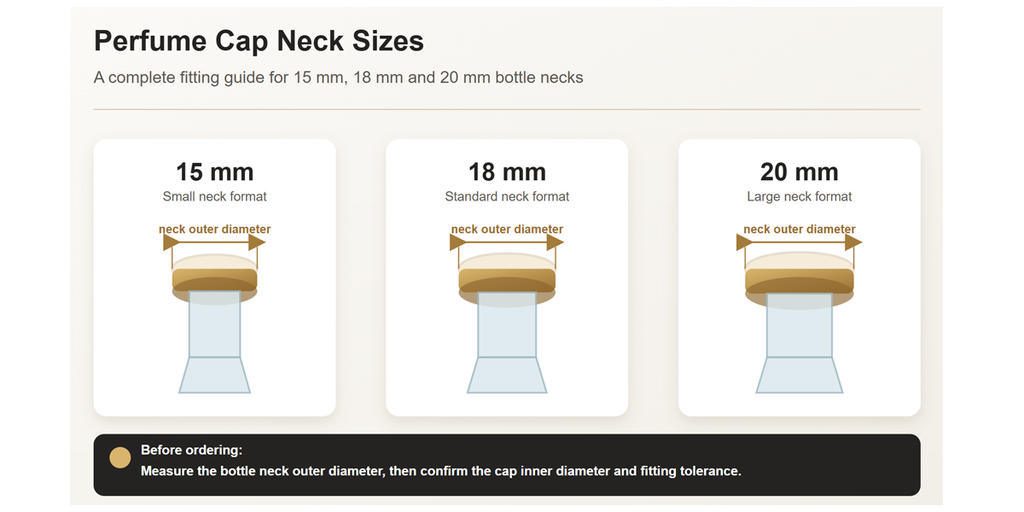
Nearly all retail fragrance bottles adhere to one of three industry-standard neck diameters, each tied to specific bottle sizes and use cases:
1. 15mm Neck
The smallest standard size, primarily used for miniatures and travel formats.
- Common bottle volumes: 5ml, 10ml, 15ml
- Typical uses: Travel perfume bottles, tester vials, mini gift sets, pocket fragrances
- Cap considerations: Smaller surface area limits logo and decoration size; lighter weight makes magnetic closures less common; precision tolerances are even more critical due to smaller dimensions.
→ Explore our full line of travel perfume bottles and caps for portable formats.
2. 18mm Neck
The global industry standard, with roughly 75% of all retail fragrance bottles sold worldwide using an 18mm neck.
- Common bottle volumes: 30ml, 50ml, 75ml, 100ml
- Typical uses: Full-size retail fragrances, unisex lines, premium and luxury collections
- Cap considerations: This size supports the widest range of cap styles, finishes, and closure mechanisms, compatible with nearly all standard perfume pump systems and allowing for magnetic closures, enamel inlays, and custom shapes.
This is the size we recommend for most new brands launching a core SKU. The breadth of compatible pumps, bottles, and cap options provides maximum flexibility at the lowest cost.
3. 20mm Neck
A larger format used for bigger bottles and more substantial pump systems.
- Common bottle volumes: 100ml, 120ml, 150ml, 200ml
- Typical uses: Large-format fragrances, body mists, home fragrance sprays, value-size SKUs
- Cap considerations: Offers a heavier, more substantial feel; popular for men’s fragrances and luxury oversized bottles; supports wider, more prominent logo surfaces.
Beyond these three standard sizes, custom neck dimensions exist, but they typically require custom inner fitment development, which incurs higher costs and longer lead times.
How to Correctly Measure Your Bottle Neck Size
“Close enough” doesn’t cut it when it comes to perfume caps. Even a difference of 0.2mm can lead to a loose fit or a cap that won’t seat properly. Follow these steps for accurate measurement:
Step 1: Measure the Outer Diameter
Use digital calipers to measure the outside diameter of the bottle neck at the point where the cap seats. Measure across the widest point of the threading or bead.
Step 2: Measure the Inner Diameter
To ensure pump compatibility, also measure the inner diameter of the neck opening. This ensures the pump stem fits correctly.
Step 3: Measure the Neck Height
Measure from the top of the neck bead down to the shoulder of the bottle. This determines how deep the cap sits and whether it will rest flush.
Step 4: Send Physical Samples, Not Just Numbers
The best way to guarantee a perfect fit is to send your manufacturer 2–3 actual production bottle samples. Drawings and measurements are a starting point, but real bottles often have slight manufacturing variances.
At JSM, we conduct a physical fit test with customer bottle samples during the sampling stage, which eliminates 99% of post-production fit issues.
Dimensional Tolerances: What “Precision Fit” Actually Means
For metal perfume caps, fit hinges on controlled tolerances. At JSM, we maintain all cap inner dimensions to ±0.1mm tolerance—about the thickness of a human hair.
Why Tight Tolerances Matter:
- Too loose: Caps may fall off during shipping or handling, rattle on the bottle, or feel cheap.
- Too tight: Caps can be difficult to remove, potentially damaging the pump or bottle neck during opening, leading to a stiff, low-quality feel.
- Uneven fit: Caps may sit crooked, creating visible gaps and looking unprofessional.
In contrast, many cheap manufacturers hold tolerances of ±0.3mm or wider. On an 18mm neck, that variation can lead to noticeable fit problems from one cap to the next.
→ Learn more about how dimensional errors cause quality problems in our guide to 10 common perfume cap quality issues.
Common Neck Fitting Problems (And How We Prevent Them)
Even with standard sizes, fitting issues can arise. Here are the four most frequent problems and how we address them at the factory level:
1. Cap Sits Crooked
Cause: Uneven neck bead on the bottle or inconsistent inner cap molding.
Our Solution: We design inner fitments with self-centering geometry to compensate for minor bottle variances. Every cap is tested on calibrated neck gauges before shipment.
2. Cap Pops Off Easily
Cause: Inner clip is undersized or retention features are too shallow.
Our Solution: Clip retention force is calibrated to 15–25N of pull force, verified through 50+ insertion/removal cycle testing. We validate against your actual bottle samples, not just generic industry specs.
3. Cap Bottoms Out Too Early
Cause: Neck height mismatch—cap hits the bottle shoulder before fully seating.
Our Solution: We verify neck height during sampling and adjust internal stop positions accordingly, which underscores the importance of physical bottle samples.
4. Pump Interference
Cause: Cap inner cavity is too shallow, pressing down on the pump actuator.
Our Solution: We design internal clearance around standard pump actuator heights and can adjust for custom pump designs upon request.
Pump Compatibility: Cap Size vs. Pump Type
Neck size determines which pump systems you can use, which in turn affects spray performance. Here’s how the standard sizes align:
| Neck Size | Common Pump Types | Typical Spray Output |
|---|---|---|
| 15mm | Mini crimp pumps, screw pumps | 0.08–0.12ml per stroke |
| 18mm | Standard crimp pumps, lotion pumps | 0.12–0.18ml per stroke |
| 20mm | High-output pumps, mist pumps | 0.15–0.25ml per stroke |
If you’ve already selected a pump supplier, share the pump technical drawing with your cap manufacturer early in the project. This ensures the cap’s internal geometry is designed around your specific pump dimensions.
5 Rules for Guaranteeing a Perfect Cap Fit
Follow these guidelines to avoid 99% of fitting problems:
- Always test physical fit samples on your actual production bottles before approving mass production. Never approve based on drawings alone.
- Share pump drawings early. The cap must be designed around the pump, not vice versa.
- Stick to standard sizes if possible. 18mm necks have the broadest supplier ecosystem and lowest costs. Custom neck sizes increase cost, risk, and lead time.
- Work with one supplier for cap and bottle if possible. Coordinating two separate suppliers is the leading cause of fit issues. If that’s not feasible, ensure both suppliers have each other’s technical drawings.
- Choose a manufacturer with tight tolerance control. ±0.1mm is the benchmark for premium metal caps. If a factory can’t provide a specific tolerance number, that’s a red flag.
All JSM cap production runs are managed under our ISO 9001:2015 and SMETA certified quality system, with first-article dimensional inspection on every production batch.
Frequently Asked Questions
Q: Are “standard” neck sizes truly universal?
A: No. While 15mm, 18mm, and 20mm necks are widely recognized as standard, actual dimensions can vary slightly between bottle manufacturers. That’s why physical fit testing is always necessary.
Q: Can you make caps fit a non-standard neck size?
A: Yes. We can develop custom inner fitments to match non-standard neck dimensions. This requires bottle samples and incurs a small development cost, but it ensures a perfect fit.
Q: Should I choose the bottle first or the cap first?
A: Always select the bottle and pump first, then design the cap around them. Bottles and pumps have fewer size options; caps can be adapted to fit standard bottle necks.
Q: How do magnetic caps affect neck fit?
A: Magnetic caps use a neck insert that fits over the standard bottle neck, with the outer cap aligning magnetically with the insert. This system works with all standard 15mm, 18mm, and 20mm necks. Learn more in our magnetic perfume caps guide.
Q: Can you adjust fit after samples are made?
A: Minor adjustments are usually possible by modifying the inner clip. However, major dimensional changes require mold modifications, which will incur additional costs and lead time.
→ For the full ordering and sampling workflow, see our step-by-step custom perfume caps OEM guide.
Conclusion
Neck size may seem like a minor detail, but it significantly impacts the perceived quality of your product. The best cap design is ineffective if it doesn’t sit straight, seat fully, and stay securely on your bottle.
At JSM, we prioritize fit as a core quality metric—not an afterthought. Every custom cap project begins with a fit review, and every production run is validated against calibrated gauges and your actual bottle samples.
If you’re planning a fragrance launch and want to ensure your caps fit perfectly on the first try, contact our engineering team today. Share your bottle and pump specifications, and we’ll recommend the right cap size, fitment design, and tolerance strategy for your project.